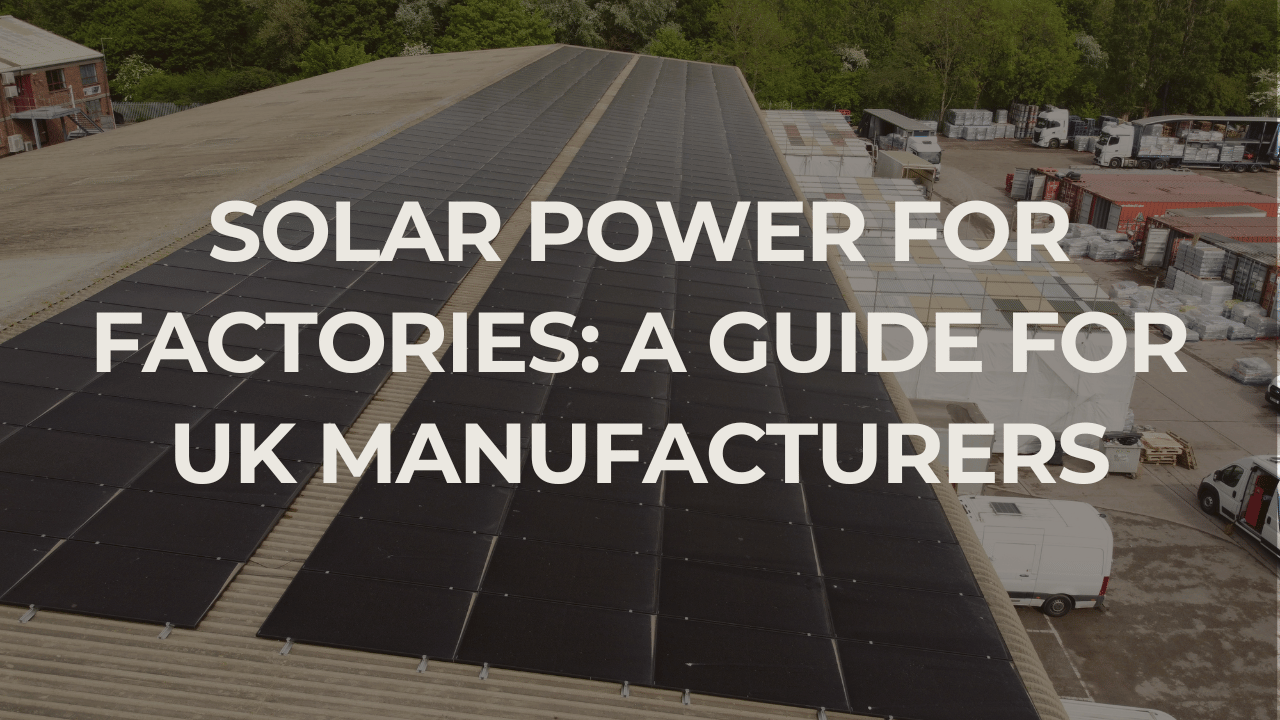
Solar power for factories allows manufacturers to generate electricity from unused roof or ground space. This can reduce the amount of energy purchased from the grid, lower operational carbon emissions and provide greater control over long-term electricity costs.
Factories are often well suited to solar panels because they typically have large roof areas and high daytime electricity demand. However, the right system size and expected return will depend on the building, its electricity consumption and the available grid capacity.
Why are factories suitable for solar power?
Many manufacturing sites have extensive roof areas that can accommodate a large solar PV system without using valuable production or storage space.
Factories also tend to consume significant electricity during daylight hours. Machinery, lighting, ventilation, cooling and compressed-air systems can use the electricity as it is generated.
This is important because electricity consumed directly on site will usually provide more value than electricity exported to the grid.
Solar power may be particularly suitable where a factory:
- has high daytime electricity consumption;
- operates throughout the working week;
- has a large, relatively unshaded roof;
- expects to remain at the site for several years;
- wants to reduce energy costs or operational carbon emissions.
How does factory solar power work?
Solar panels generate direct-current electricity from daylight. Inverters convert this into alternating current that can be used by the factory.
The generated electricity is supplied to machinery, lighting and other equipment. When the factory requires more electricity than the panels are producing, additional power is imported from the grid.
When solar generation exceeds demand, the surplus may be exported or stored in a compatible battery system.
The installation works alongside the factory’s existing electrical supply. It does not normally replace the grid completely.
Benefits of solar panels for factories
Lower electricity costs
Electricity generated and consumed on site replaces some of the power that would otherwise be purchased from an energy supplier.
The potential saving depends on:
- the size of the solar system;
- annual solar generation;
- the factory’s electricity tariff;
- how much solar electricity is used on site;
- maintenance and finance costs;
- the value of exported electricity.
Solar panels will not remove every charge from an electricity bill, but they can reduce exposure to purchased electricity.
Greater cost certainty
Solar provides an on-site source of electricity that is less directly affected by changes in wholesale energy prices.
It does not fix the cost of all the factory’s electricity, but it can make the cost of the self-generated portion more predictable.
Lower operational emissions
Solar panels generate electricity without burning fuel at the point of use. Replacing grid electricity with on-site renewable generation can therefore reduce the operational carbon emissions associated with the factory.
Productive use of roof space
Installing solar panels can turn a suitable industrial roof into an electricity-generating business asset without taking up internal production space.
How much does factory solar cost?
There is no standard price for solar power for factories. Costs vary according to the size and complexity of the installation.
The main factors include:
- system capacity;
- roof type and condition;
- structural requirements;
- scaffolding and access;
- electrical infrastructure;
- switchgear or transformer upgrades;
- grid-connection requirements;
- export-limitation equipment;
- battery storage;
- installation scheduling.
A site survey and review of the factory’s electricity data are needed before meaningful costs and savings can be calculated.
How is a factory solar system sized?
A factory solar system should be designed around electricity demand rather than roof size alone.
The assessment should consider:
- at least 12 months of electricity consumption;
- half-hourly usage data where available;
- weekday and weekend demand;
- operating hours;
- seasonal production changes;
- available roof or land area;
- future machinery or electric vehicle charging;
- permitted grid-export capacity.
The largest possible installation is not always the most commercially effective. The aim is to balance generation, self-consumption, available space and project cost.
Can solar keep a factory running during a power cut?
Standard grid-connected solar panels normally shut down during a power cut. This prevents the installation from sending electricity into the network while engineers may be working on it.
Maintaining power during an outage requires a specifically designed backup system. This may include:
- battery storage;
- backup-compatible inverters;
- isolation and transfer equipment;
- dedicated essential-load circuits;
- suitable controls and protection.
A standard solar battery does not automatically provide factory backup. The required system will depend on which machinery or operations must continue during an outage.
What should be checked before installation?
Before installing solar panels on a factory, the project team should assess:
- the condition and remaining life of the roof;
- structural loading capacity;
- asbestos or fragile roofing materials;
- roof warranties;
- shading and roof obstructions;
- fire-safety requirements;
- electrical connection capacity;
- safe maintenance access;
- potential disruption to production.
Some installations may also require planning approval or permission from the local Distribution Network Operator.
These issues should be investigated early because they can affect the design, cost and project programme.
Are batteries suitable for factories?
Battery storage can be useful where there is a clear operational or financial objective.
A battery may help a factory:
- use more of its solar electricity on site;
- reduce demand during peak periods;
- store lower-cost electricity for later use;
- limit solar exports;
- support selected essential loads during an outage.
Battery storage adds cost and introduces considerations including degradation, usable capacity, fire safety and warranty terms. It should therefore be assessed separately rather than included automatically.
Is your factory suitable for solar power?
A factory may be a strong candidate for solar where it has substantial daytime electricity demand, sufficient installation space and a roof in suitable condition.
An initial feasibility assessment should review:
- electricity bills and half-hourly consumption data;
- roof drawings and site conditions;
- available grid capacity;
- suitable system size;
- expected generation and self-consumption;
- indicative costs, savings and payback;
- battery requirements where relevant.
Financial forecasts should clearly state the assumptions used and should not be presented as guaranteed savings.
Request a factory solar assessment
Solar power for factories can reduce grid electricity use, support carbon-reduction targets and turn unused roof space into an energy-generating asset.
SGS Energy designs commercial solar systems around each site’s electricity demand, building constraints and operational requirements.
To request an initial factory solar assessment, provide:
- the site address;
- recent electricity bills;
- half-hourly consumption data where available;
- roof plans or drawings;
- details of operating hours and planned expansion.
Contact SGS Energy to discuss whether solar power is suitable for your factory.
Frequently asked questions
Are solar panels worth installing on a factory?
They can be where the factory has high daytime electricity demand, suitable roof space and a long-term requirement for the premises. The decision should be based on a site-specific assessment.
How many solar panels does a factory need?
The number depends on electricity use, available space, panel output, grid capacity and the factory’s objectives.
Can a factory run entirely on solar power?
Most factories will continue to import electricity because solar output varies throughout the day and year. Battery storage may increase self-sufficiency but requires separate assessment.
Do factory solar panels generate electricity in winter?
Yes. Solar panels generate throughout the year, although output is normally lower during the shorter and darker winter months.